Top 7 CSS Frameworks in 2020
The 7 Best CSS Frameworks to use next year
If you’re a developer then you probably already know how much time CSS frameworks help you save when creating applications and websites. If your new to web developing, or fairly new, CSS frameworks are basically structures that continuously create solutions to target common problems within front end development.
So to put it into simple terms, pretend that you're building a cabinet or drawer straight out of the box. You have the instruction sheets, screws, bolts and tools laid out and you're ready to get building right? Well just like when building anything you have to have a structured, well-organized plan before beginning your project in order to save you time and stress. (I know it does for me)
It helps developers not have to start from scratch by providing generic functionality that they can turn into applications hence the popularity of them. As pretty much any development tool, they are constantly advancing and being upgraded. This is why you need to stay up to date with the latest frameworks to make sure you're being as effective and productive as possible.
But enough talking, now that you have a basic understanding of what exactly is a CSS Frameworks, let's talk about what you came here for! Here is my predicted list of the top web UI design frameworks to use in 2020.
1.Bulma

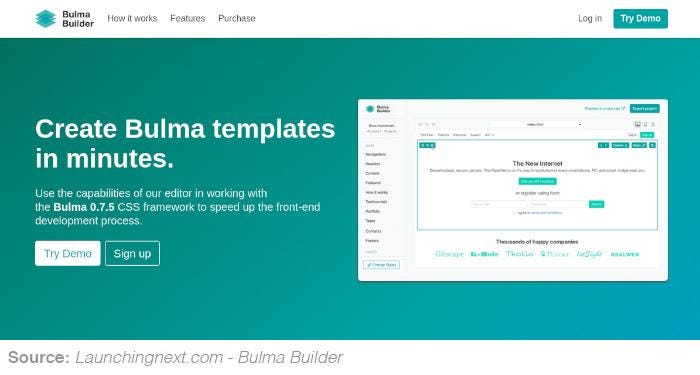
Another exceptionally respected CSS system that incorporates no JavaScript is Bulma.
Its segments are adaptable and are actually very easy to examine, making the development experienced a significant addition to its advantages. The mobile-first structure of Bulma guarantees a versatile arrangement, so any blueprint you create with the system will look extraordinary on any cell phone.
Bulma utilizes a cutting edge design framework called Flexbox, which is reinforced by every single major program, making it simple to format the layout. The web design model is a decent element for engineers searching for consistency and solidness.
One downside to Bulma is the structure doesn’t have as extensive documentation as some of the other systems. While many developers are still utilizing it, as a result of its originality, you may run into certain issues when troubleshooting because it could take a user longer to fix the issues.
In spite of its freshness, Bulma is a cutting edge structure with format abilities designers love. If you like easy-to-create layouts with consistency, then you should consider Bulma for your next undertaking.
2.Bootstrap

Bootstrap is without-a-doubt one of the most popular responsive frameworks currently and will continue to do so in 2020. Bootstrap provides a solid foundation for any website and even a novice developer that knows basic HTML and CSS can get started right away. Bootstrap is a fully-featured framework that is very well established and provides extremely thorough documentation which is why it’s a top choice for many developers.
Bootstrap provides a very powerful grid system that is simple to use and can come in handy when trying to compose a quick prototype. The customizable design is another great feature that developers love as you can override the CSS and default Javascript behavior.
So if you're into functionality and stability then consider using Bootstrap for your next project.
3.UIkit


Uikit is another one on the list that you should possibly consider learning to use in 2020 as it provides a lightweight, modern framework that focuses greatly on creating web interfaces.
Some reasons why many like this framework are because it comes with built-in animations and is ready to use out-of-the-box.
It allows for customizations such as the HTML Editor and Flex which make it a great option for developers who like flexibility and freedom. So if your slightly more experience in front end-developing then this could be a nice framework to look into.
4.Foundation

Foundation is a great option for more advanced developers who prefer fully-featured and highly flexible frameworks.
Its layout is great for mobile, tablets and even desktop screens that make it a great option for a larger business looking to maximize their project's abilities.
Many developers really like it’s built-in form features and its unique components such as keystrokes, Flex and Joyride. It is a very straightforward and extremely responsive design that would make it a great option moving into 2020 for some more advanced users.
5. Semantic UI

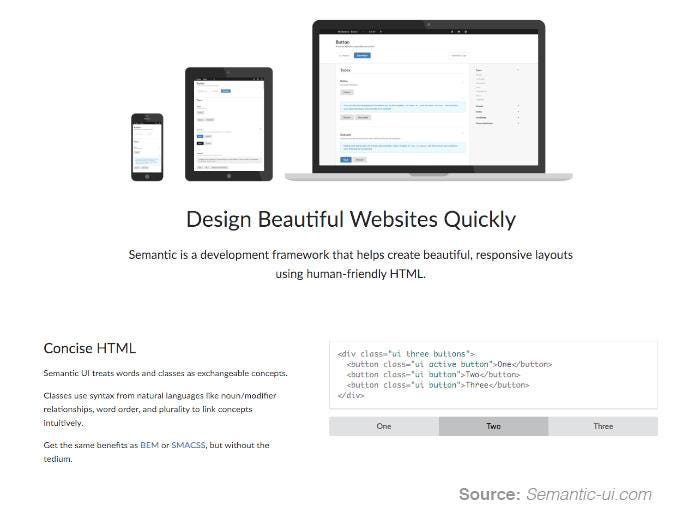
Semantic UI was designed to be a simple and easy framework to understand making it a popular option amongst developers, for its well-organized documentation and its human-friendly HTML.
The idea behind Semantic UI was to include a wide variety of components and settings that will make your design look incredible.
If you're like me and like to create some beautiful and responsive websites than Semantic UI could be a good choice for you.
6. Material UI

Material UI is heavily influenced by Bootstrap, yet is robust and reliable. Its lightweight framework helps you create fast-loading applications under an open-source framework.
It’s very easy to customize and great for performance, however, it is advised for smaller projects.
So if you need a fast and lightweight framework then you should look into Material UI going into 2020.
7. Tailwind

Tailwind uses an intuitive design that makes it great for building the user interface. One big advantage for me with Tailwind is that your component classes tend to be way more efficient than before.
It is a little bit more complex, learning wise but it’s well worth the time spent into developing with Tailwind. I like the fact that you can literally build everything from the ground up by using the utility classes.
So if you're up for the challenge I would definitely look into implementing Tailwind CSS for your next project.
Conclusion
So as you can see I have included some frameworks that could be right for you. Since it really comes down to personal preferences I can't really decide for you, but I am sure that you will find which one is right for you.
Find which one would best fit for your next project, whether big or small there is the right framework for you. Some things you should consider when choosing one is if it has enough support for you to keep up? Is it scalable for your project in the future? Does it have poor or extensive documentation?
There is neither a right or wrong when deciding, you can find unique value in each of these CSS Frameworks. Although this is my personal predictions, this is by no means a set-in-stone list of frameworks, as there are constantly being improvements made all the time. After all, developers should always be learning the next big thing if they want to continue building their portfolio of languages.


Comments
Post a Comment